
Mandela, Struggle and Triumph, Part 1
Here is the first part in an incredible story behind a photojournalist’s 30-year commitment to creating a timeless document of one of the most transformational events in recent world history.
David C. Turnley is a Pulitzer Prize-winning photographer and filmmaker acclaimed for his incisive and unforgettable images of world events like the fall of the Berlin Wall and the Tiananmen Square uprising. A four-time runner-up for the Pulitzer, he is also a two-time winner of the World Press Picture of the Year and has won four Overseas Press Club Awards. In addition to covering many of the major news events over the past 30 years, his first film “The Dalai Lama: At Home in Exile” produced by CNN was awarded the 2001 CINE Golden Eagle and nominated for an Emmy, and his film “La Tropical” shot in Cuba was awarded Best Documentary at the Miami International Film Festival. David has also won the Robert Capa Gold Medal of Courage and published seven photographic monographs of his work. As a commercial director, he recently directed a Nike Air Jordan commercial with Wieden +Kennedy.
Above all, David Turnley is a passionate and committed photographer who is dedicated to overcoming the fear and mistrust that separates and divides people. Here is the remarkable story behind his heartfelt and brilliant coverage of the South African struggle to overcome apartheid and its aftermath.


Here is the first part in an incredible story behind a photojournalist’s 30-year commitment to creating a timeless document of one of the most transformational events in recent world history.
David C. Turnley is a Pulitzer Prize-winning photographer and filmmaker acclaimed for his incisive and unforgettable images of world events like the fall of the Berlin Wall and the Tiananmen Square uprising. A four-time runner-up for the Pulitzer, he is also a two-time winner of the World Press Picture of the Year and has won four Overseas Press Club Awards. In addition to covering many of the major news events over the past 30 years, his first film “The Dalai Lama: At Home in Exile” produced by CNN was awarded the 2001 CINE Golden Eagle and nominated for an Emmy, and his film “La Tropical” shot in Cuba was awarded Best Documentary at the Miami International Film Festival. David has also won the Robert Capa Gold Medal of Courage and published seven photographic monographs of his work. As a commercial director, he recently directed a Nike Air Jordan commercial with Wieden +Kennedy.
Above all, David Turnley is a passionate and committed photographer who is dedicated to overcoming the fear and mistrust that separates and divides people. Here is the remarkable story behind his heartfelt and brilliant coverage of the South African struggle to overcome apartheid and its aftermath.
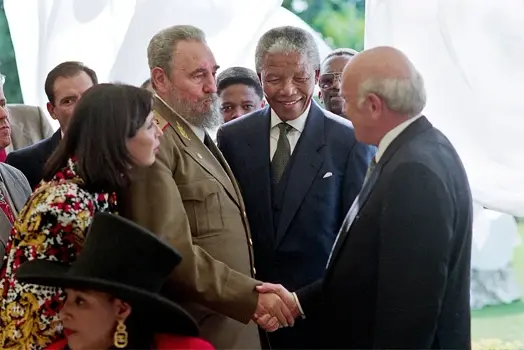
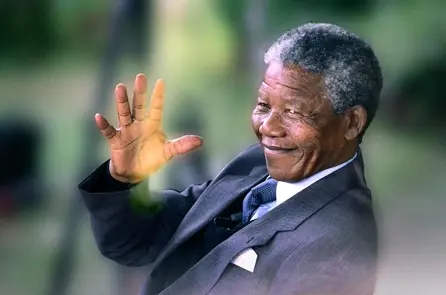
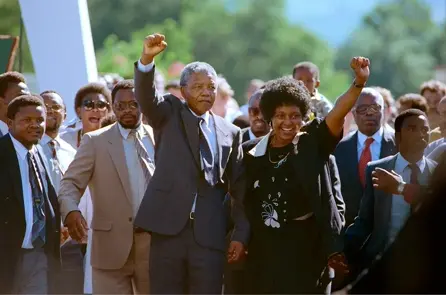
Q: You obviously started this long-term project on Nelson Mandela and South Africa before you knew how it would end. Is that true, and how did it unfold?
A: Absolutely. Thinking about that might be a good place to start our conversation.
Q: You are an internationally acclaimed photojournalist and you’ve covered important world events before. What motivated you to start this project, especially not knowing what the outcome would be?
A: I think it starts with my own childhood growing up in the Midwest in Fort Wayne, an industrial town in Indiana. I got very lucky in the parent department. My mother and father both were raised in Indiana. I was 13 years old in 1968 when Dr. King was assassinated and the era we were being raised in and especially in the case of my family who believed in his eloquent words, that we are all created equal. I must admit that growing up in Fort Wayne in the late ’50s and ’60s was a very segregated city in a de facto sort of way. It was effectively a black and mostly working class, poor inner city and everything else was white and middle to upper class. My high school wasn’t actually desegregated until my sophomore year.
My father was an extraordinary athlete. His father was an extraordinary athlete. I am an identical twin. With those kinds of family members growing up in the Midwest you do what they did. So by the time I was a little kid I was obsessed with sports and I was a pretty good football player, as was my twin brother. Our team at school was desegregated during my sophomore year. It was not only integrated but also became very good. Our black teammates would get on a bus after practice and be bussed back to the inner city not to be seen. I remember having an acute awareness from that time of my life that so much was going on across our country. There were race riots in Detroit, LA, and Newark, New Jersey. Again given my family, I was very aware of the civil rights movement.
It was then when my brother Peter and I were 17 and playing football, that he tore up a knee in a football injury. When he was in the hospital my father gave him a camera and a couple of books. One was by the great French photographer Henri Cartier-Bresson. Another was a book by Bruce Davidson documenting a block in Harlem. In looking at those photographs Peter and I felt the same way. What was so powerful was the photographer, and what he had achieved. I didn’t know his race or much about him. All I knew about him came from looking at those photographs. And it was very clear that the photographer had earned access to the people in these images on their terms. In looking at those images, the notion that we are all created equal really started to make sense to me. What I would see in these photographs was that the people just sort jumped off the page; it was their inherent dignity in each case, and I got it. That was powerful having been raised in an environment that had been really divided. I know that for both Pete and I, that photography was not only an opportunity for us express a creative sensibility inside of ourselves that we hadn’t tapped into, but also a powerful voice to scream with.
Photography allowed people to get past the walls that get constructed around us out of fear, to move beyond the comfortable caricatures that people seem to make about one another. This began a process for me that was so incredibly exhilarating that I haven’t stopped feeling ever since and measuring the lives of people that I like to call the “family of man” in all its diversity —ethnically, racially, sexually, geopolitically, and in terms of gender identity. By the time I finished at the University of Michigan I started to work at a small chain of newspapers for three years.
I got ahead of myself and skipped over an important chapter … So we got this camera when we were 17 and still in high school. We spent the next two years with one camera and one lens and started photographing on an inner city street, McCullen Street in Fort Wayne. It wasn’t a particularly racially mixed street but it was a poor, mostly white working class street. The work we did on that street over those two years became a book called “McCullen Street” which was published just a few years ago, many, many years later. I’m very proud of it. It was received very well and has become almost a cult book of documentary photography.
Q: You said something very interesting about photographing people like in Bruce Davidson’s book “East 100th Street,” that not only did he have access but he had empathy. He was photographing people on their own terms. There was a connection and that aspect is quite evident in your portfolio.
A: That’s what I was trying to get to. I was working at the Free Press in Detroit from 1980-1985, and by that time Detroit was equally an incredibly segregated city. Ever since the race riots in 1967 there had been this massive white flight to the suburbs and Detroit went from being one of the most successfully integrated cities in the country because of the European immigrants and blacks from the south that came to work in the automobile factories as well as working class whites. But after the race riots in ‘67 it literally became a black city with white suburbs. Before I even got to Detroit, when I was in Ann Arbor, Michigan reading the Detroit Free Press, in the early ‘70s, you would have thought there were no black people living in the city. There were never any black people in the photographs unless they were being spoken about as criminals and it always affected me because the city was 99 percent black.
The reality was that by the time I got to the newspaper and started working there it became evident to me that most of the journalists at the paper were white, probably lived in the suburbs and probably comfortable with that kind of storytelling. I spent five years in Detroit, at a time that Life Magazine had folded, essay photography had been picked up by newspapers, and the Free Press would run an essay every day on the back page of the paper. So I spent my five years trying to tell real stories about the people of Detroit on that back page.The first story I did I was really proud of. I went to a Coney Island hot dog restaurant at lunch and I was sitting next to an elderly black gentleman and we had a great conversation. We talked for about an hour and as he was getting up to go I asked him what his name was and he said, “Henry Ford is my name.” So my first essay was about the other Henry Ford for the Detroit Free Press. By the time I was in Detroit in 1985, South Africa was raging and on the brink of revolution. It had become the international pariah state and so many Americans were outraged that any society could basically exempt people from their basic human rights and citizenship simply by the color of their skin. I was able to get a visa and proposed to the paper to send me to South Africa.
On the one hand, my motivation was to try to understand this system that was unimaginable to me. On the other, it was an opportunity to learn about racism and discrimination in our own country. In South Africa it was a system that allowed the white minority to dominate over the black majority. In some respects the actual day-to-day indignities and humiliations that come with a master/servant relationship were not so unlike the dynamics I was witnessing in our own country. So it was a chance to contribute to the South Africa struggle, but also to show America and other countries photographs that in the most blatant way speak to this phenomenon that isn’t exclusive to South Africa … what it is that is that actually triggers fear and motivates discrimination.
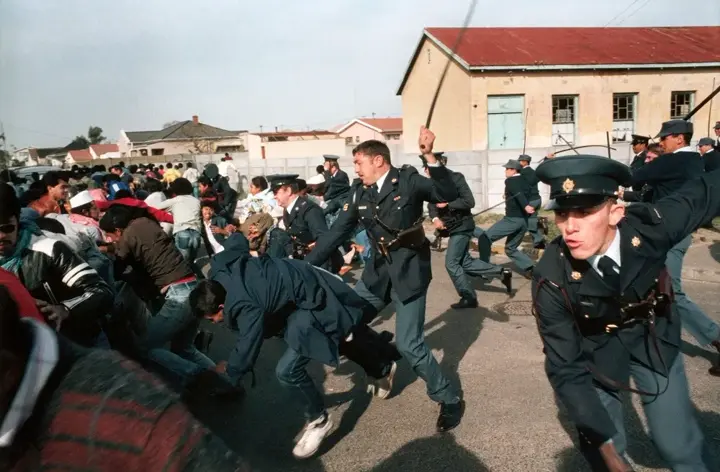
It was a perfect fit for me with my own background and motivations. It was a privilege to be there. One of the first weeks I was there an event unfolded down in Capetown where an activist named Alan Bousak meant to lead a march from a mixed race town called Athlone. The march was meant to walk to a local prison where they had moved Nelson Mandela onto the mainland after he had been on Robin Island for 16 years. That particular day I made a photograph of hundreds of South African police storming the crowd with horsewhips to break up the march. I made a photograph that was very dramatic and published around the world. That event kicked off a state of emergency. From that time on there were fires, and basically a revolution. That was what my stay was like. I thought this aspect of the struggle was important to show. But I also thought it was important to delve into the everyday lives of the people, kind of the rainbow spectrum of race in South Africa, and to witness the less dramatic brush strokes, the sort of the daily individual humiliation and indignation that people were experiencing.
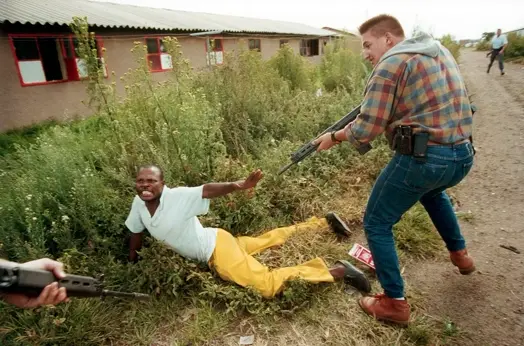
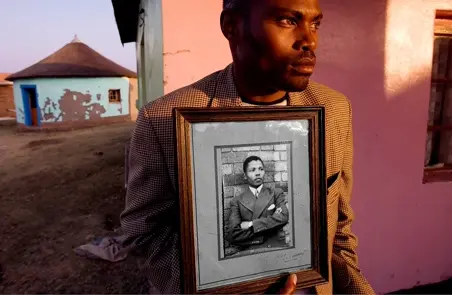
Q: When looking at some of these images, one may think “Oh my God, this guy must have been in danger for his life at certain points.” It required some degree of dedication and bravery to stand there and take these photographs, didn’t it?
A: Back in 1978 I remember being at a National Press Association seminar in Youngstown, Ohio. A black South African photographer name Peter Magubane had been invited to show his work. He had been there back in 1976 when black students in high schools in Soweto, South Africa would no longer accept being forced to learn the language of the oppressors, so they left their high schools and took to the streets. Over the course of a week there were somewhere between 300 and 800 people who were injured or killed. Peter documented the Soweto uprising in 1976 and he showed these photographs. It was very clear that he had put his life on the line. He was so eloquent and so generous of spirit. He was really the first person who exposed me to what I call a Mandela-like spirit. He had endured prejudice in South Africa his whole life. But you didn’t feel that he had an axe to grind. It felt more that he was giving his life as a photographer and was only too willing to do so in order to find a resolution that would give people of all races in South Africa the opportunity to live with their heads high. He inspired me.
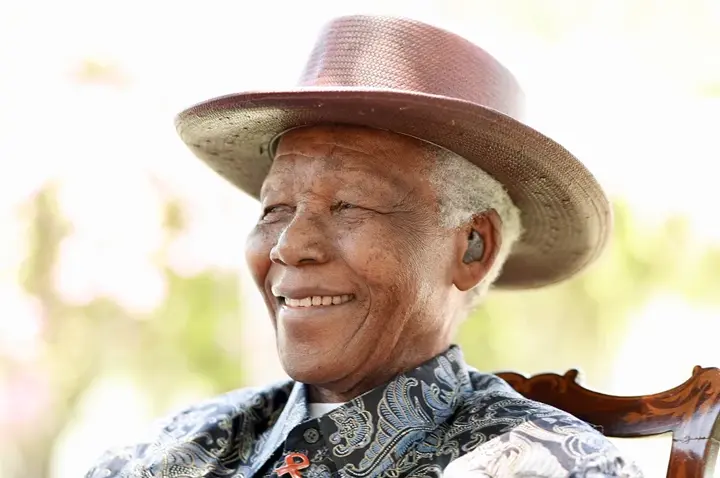
When I got to South Africa in 1985 I was asked by Life Magazine to do an essay photographing Winnie Mandela and her two daughters. We immediately connected and we are still in touch to this day. People like them, who were willing to go to prison because of their beliefs, humbled me by the enormous sacrifices they were making.
Q: If you take a look at the images, it seems to be that they uphold the journalistic ideal of truth without judgment. This is really what’s happening. It’s not that there are the good guys and the bad guys. Somehow there is something overarching that they are moving toward, something transformational. Like you said back at the beginning, “reconciliation, we are all one” and that is a fundamental truth of the human experience. We are all one on this tiny planet. We have to find ways of getting along and doing something positive, and transcending our prejudices and our narrow views. That’s really what comes through in this documentary.
A: I couldn’t agree more with you. As tragic and unjust as apartheid was, I felt, interestingly, that there was a tremendous amount of hope and that, while the system was that much more Machiavellian, in some ways there was a sense of hope that I hadn’t felt in my own country. That if the society might be able to remove the shackles of this system, they might be able to get some things really right. And the truth was, the work was an opportunity to look at this, but it was also an opportunity to try to inspire hope in our own country. To me, the work they were doing in South Africa echoed to me about my own country.
Thank you for your time, David!
– Leica Internet Team
Editor’s note: For convenience we’ve presented this interview in a Q and A format, but it is actually a dialogue.
Learn more about David on his website, Facebook and Twitter. Watch the video “A Tribute for Nelson Mandela – For Madiba with Love – Photographs by David Turnley” here. David has just completed a feature length documentary – a five year project titled “Shenanodah” in a coal mining town in Eastern Pennsylvania where four young white football players had beaten to death an undocumented Mexican immigrant. This highly acclaimed film will be available soon on