
Historically significant cameras and vintage camera accessories take center stage at the 48th edition of the Leitz Photographica Auction, set to take place on 13th June at the World of Leica in Wetzlar. The highlights include two Leica MP cameras from the 1950s, purpose-built for photojournalism, as well as a late 19th-century Lumière Cinématographe—one of the groundbreaking devices used to record and project the world’s earliest motion pictures. Bidders can participate live on-site, via telephone, or online. Separate from the event, Leitz Photographica Auction will host an additional online-only auction titled “Leitz ON” from 13th May to 14th June. Leitz ON offers a broad spectrum of cameras, camera accessories, and photographs spanning from the 1920s to the present day.
Leitz ON
“Each year, a plethora of cameras, lenses, and photographic equipment are submitted to us. Due to time constraints, we cannot include them all in our main auction. For this reason, we have decided to introduce an additional online-only auction titled ‘Leitz ON’”, explains Alexander Sedlak, Managing Director of Leitz Photographica Auction.
Bidding for “Leitz ON” lots will be open from 13th May to 14th June. “Estimates range from the high three-figure to the low five-figure euro segment,” Sedlak adds. More exceptional rarities, including pieces from the high-end segment, will be featured in Leitz Photographica Auction 48, taking place on 13th June at Leica Welt in Wetzlar. Bids can be placed live on site, in written form, online or by telephone.
Rarity in black paint
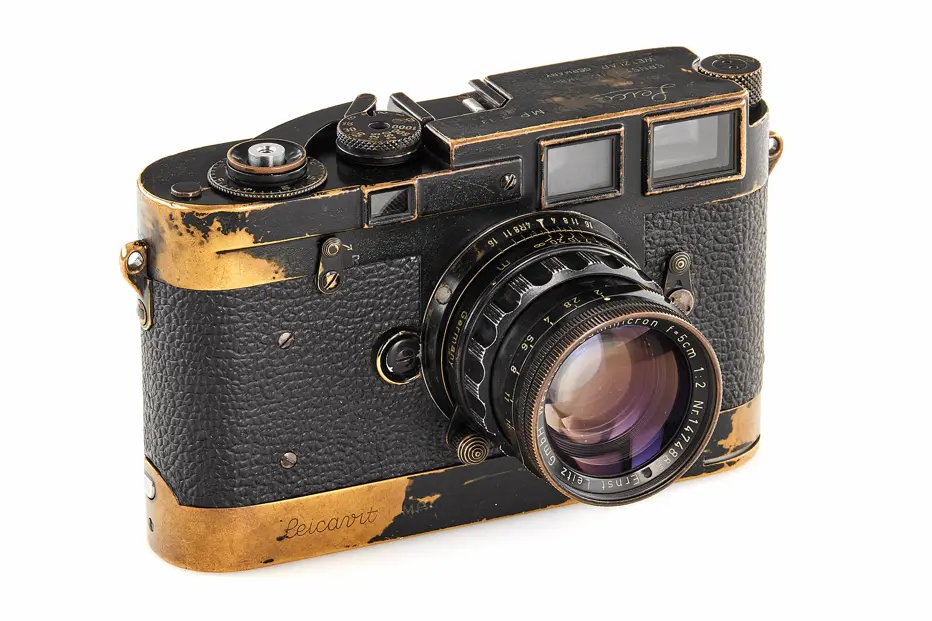
One of the standout rarities is the Leica MP-33 black paint. With only 402 units – just 141 of them in black paint – ever produced, the “M Professional” (MP) ranks among the rarest Leica cameras ever made. The concept originated from requests by prominent American press photographers such as Alfred Eisenstaedt and David Douglas Duncan who sought to combine their M-series cameras with the advantages of the Leicavit rapid winder, then available only for the Leica IIIf. The example offered now, MP no. 33, was originally delivered to Brandt, Sweden, on 29 July 1957 and is accompanied by a matching black paint Leicavit and a black paint / brass-mount Summicron 2/5cm lens no. 1474885.
The camera of the first Paparazzo
With only 261 units produced, chrome-finished MPs are also hugely popular with collectors. A particularly interesting chrome MP – due to its distinguished provenance – will be offered at Leitz Photographica Auction 48. Delivered on 1st January 1958, the Leica MP no. 368 was documented as the personal camera of Tazio Secchiaroli. His dynamic and candid photographs of celebrities along Rome’s Via Veneto in the late 1950s profoundly influenced modern photojournalism and even inspired a now iconic character in Federico Fellini’s La Dolce Vita (1960). Said character was called “Paparazzo” and would eventually go down in history by lending its name to a new phenomenon in photography culture.
A pioneer in reducing camera shake
Historically significant camera accessories are likewise in focus at Leitz Photographica Auction 48. Of these accessories, the E. Leitz New York Leica Gun RIFLE, is one of the rarest and most unusual. Inspired by Commander Attilio Gatti, a renowned wildlife photographer, the RIFLE was designed to reduce camera shake while handling telephoto lenses and was therefore often used to cover sports events. Estimates of the total production vary, but it appears realistic that a mere total of 12–14 E. Leitz New York Gun RIFLES were produced. A distinctive feature is the specialized viewfinder bearing the engraving “Patent Pending.”
Lumière Cinématographe Set
A landmark piece of cinematic history will be offered in the form of Lumière Cinématographe no. 207. Patented by Auguste and Louis Lumière, the Cinématographe was the first practical and commercially viable apparatus capable of recording, printing and projecting motion pictures within a single compact, hand-cranked mechanism. Its public debut on 28 December 1895 at the Salon Indien du Grand Café in Paris — the first ticketed public film screening in history — is widely regarded as the birth of commercial cinema. It remains unknown which Cinématographe unit was used at said screening. However, the Lumière system, lightweight and mechanically sophisticated, rapidly spread across Europe and internationally, establishing motion picture exhibition as a new industry.
Live on site, in written form, online or by telephone
Leitz Photographica Auction 48 will take place on 13th June, starting at 11 a.m. CET, at Leica Welt in Wetzlar, Germany. Bids can be submitted in advance online (www.leitz-auction.com), in written form, or by telephone. Live bidding during the auction will be available via www.leitz-auction.com and www.liveauctioneers.com.
In autumn, Leitz Photographica Auction will host two additional sales. On 9th October, the photographs auction “Perspectives” will take place at Leica Galerie Vienna, followed by the Leitz Photographica Auction 49 on 28th November, once again at Leica Welt in Wetzlar.
About Leica Camera Classics
The German Leica Camera AG has two branches in Vienna: Leica Camera Austria and Leica Camera Classics. The latter specializes in vintage cameras and has approximately 1,500 devices on display in its store at Westbahnstraße 40. The location also houses the largest spare parts warehouse for historic Leica cameras in the world. Because of this unique inventory, on-site technicians can inspect historic Leica cameras to the highest collector standards and restore them as needed before they are auctioned.
Twice a year – in mid-June and late November – Leica Camera Classics organizes the Leitz Photographica Auction, the world's most important auction of vintage cameras, attracting bidders from over 100 countries. In addition, around 5,000 products are permanently offered in the LCC online store.
Please find further information at:
Leica Camera AG
Global Corporate Communications
E-Mail: press@leica-camera.com
Press_Release_Leitz-Photographica-Auction-48.pdf
English
Acerca de Leica Camera
Leica Camera AG es un fabricante internacional de gama alta de cámaras, objetivos y productos de óptica deportiva con más de 150 años de historia. Como parte de su estrategia de crecimiento, la empresa ha ampliado su negocio con la incorporación de Mobile Imaging (smartphones) y la fabricación de lentes para gafas y relojes de alta calidad, y está representada en el segmento del cine en casa con sus propios proyectores.
Leica Camera AG, con sede en Wetzlar (Alemania) y un segundo centro de producción en Vila Nova de Famalicão (Portugal), cuenta con una red mundial de distribuidores propios formada por más de 120 Leica Stores. La empresa tiene una plantilla de 2400 empleados y alcanzó una facturación de 554 millones de euros en el ejercicio 2023/24.
La marca Leica es sinónimo de calidad excelente, artesanía alemana y diseño industrial, combinados con tecnologías innovadoras. Un componente fundamental de la cultura de la marca es la promoción de la cultura de la fotografía, con unos 30 establecimientos Leica Gallery y Leica Akademie en todo el mundo, además de conceder premios internacionales como el «Leica Hall of Fame Award» y el «Leica Oskar Barnack Award» (LOBA).