
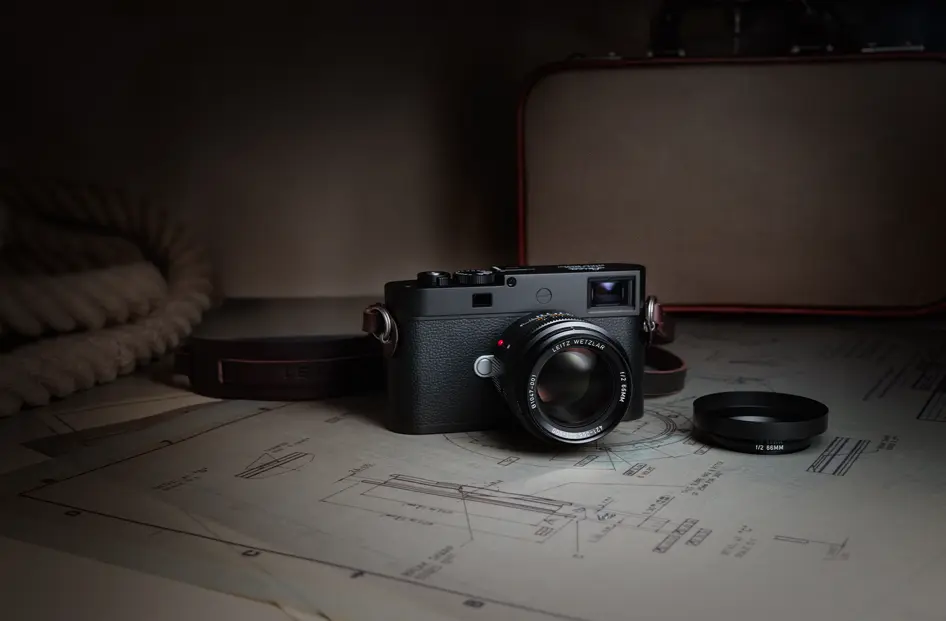
This reinterpretation of the historic spy lens extends the Leica Classic Line by adding the unique 66 mm focal length
Dr Walter Mandler developed the Elcan 66 mm f/2 at Ernst Leitz Canada in the late 1960s. Designed for use by the US Navy, only around 200 units were produced. This makes the lens one of the rarest in the Leica M-System, giving it special optical and historical significance. To honour this lens, Leica Camera AG is presenting a reinterpretation of it by expanding its Classic Line with the new Summicron-M 66 f/2.
Dr Mandler was already regarded as a leading authority in optical design back then. He developed a bespoke lens for covert reconnaissance photography in response to a US Navy commission. According to Dr Mandler, Head of Development and Vice-President of Ernst Leitz (Canada) Ltd. in Midland, Ontario, at the time: “The Naval Intelligence Service wanted a lens that looked like any other but delivered an unparalleled level of resolution.” The unusual focal length of 66 mm was no coincidence, but rather the result of striking a precise balance between maximum resolution, fine contrast rendition and a compact design. This extraordinary, rare spy lens, with a purely military history, embodies one of the most extraordinary chapters in the history of the Leica M.
Historical accounts also suggest that equipment of this type found use beyond its original US Navy commission, among Western allied partners during the Cold War. Many Elcan 66 mm f/2 lenses are also associated with the Leica KE-7A, the special military variant of the Leica M4. Together, camera and lens formed compact sets for discreet photography in situations where exceptional detail was essential.
The original sets were supplied with an instruction manual that explained how to destroy the camera and lens in the event of capture. Striking in retrospect, this detail reflects the sensitivity of the assignments for which the equipment was created, while the lens itself remains remarkable for the optical performance that made such use possible.
The new Summicron-M 66 f/2 continues this story and represents the first time that Leica is making this focal length available to all photography enthusiasts. While the optical design is based on the original, it has been optimised and adapted to meet today’s standards, just like the lens body. As with the Elcan, the Summicron-M 66 f/2 differs mechanically from standard Leica models: its aperture ring rotates in the opposite direction to that of standard M-Lenses, and the distance scale arrangement follows military specifications. The engravings are reminiscent of the original design and have been reinterpreted for the Summicron-M 66 f/2. Thanks to a visibly finer typeface, the new 66 mm focal length stands out from current Leica lenses.
The Summicron-M 66 f/2 range is being released in a limited edition of 660 units. The special serial number is engraved on the front ring alongside the optical calculation number B1047 and the 12-digit internal material number. This is similar to the original, which featured the production number and the initial calculation number C283, as well as the 13-digit US Navy order number, in the same position. Additionally, the ‘Leitz Wetzlar’ engraving on the front ring replaces the previous model name ‘Elcan’, which stood for Ernst Leitz Canada back then. Another stand-out detail is that the small, engraved number ‘60’ on the side of the lens indicates the exact focal length. This was customary for precision lenses at the time and is testament to the Leica factory’s precise manufacturing. In order to specify the focal length with the utmost accuracy, the digit before and after the decimal (without a decimal point) were also engraved on the lens. Therefore, the marking ‘60’ stands for a precisely measured focal length of 66.0 millimetres.
With a maximum lens speed of f/2, the Summicron-M 66 f/2 produces images with distinctive rendering, as do all lenses in the Leica Classic Line. This is characterised by the interplay of soft bokeh and high contrast. When stopped down, its original purpose becomes apparent: maximum resolution for clearly reproducing the finest details. With a focal length between that of the classic 50 mm lens and longer portrait focal lengths, it offers a natural perspective and subtle image compression. This reinterpretation of a classic carries its own history into the present, capturing today’s moments in exceptional quality.
The Leica Summicron-M 66 f/2 will be available worldwide from 3 September 2026 in Leica Stores, on the Leica Online Store and from authorised dealers. The recommended retail price is €9,850.00 including VAT.
In November 2026, the Summicron-M 66 f/2 with serial number 001 will be auctioned at Leitz Photographica Auction in Wetzlar. As the first-numbered lens in the worldwide limited edition of 660 units, it holds a special position. The auction offers a unique opportunity to acquire this exceptional example of contemporary Leica history.
Please find further information at:
Leica Camera AG
Global Corporate Communications
E-Mail: press@leica-camera.com
Press Release: Leica Summicron-M 66_f2.pdf
Acerca de Leica Camera
Leica Camera AG es un fabricante internacional de gama alta de cámaras, objetivos y productos de óptica deportiva con más de 150 años de historia. Como parte de su estrategia de crecimiento, la empresa ha ampliado su negocio con la incorporación de Mobile Imaging (smartphones) y la fabricación de lentes para gafas y relojes de alta calidad, y está representada en el segmento del cine en casa con sus propios proyectores.
Leica Camera AG, con sede en Wetzlar (Alemania) y un segundo centro de producción en Vila Nova de Famalicão (Portugal), cuenta con una red mundial de distribuidores propios formada por más de 120 Leica Stores. La empresa tiene una plantilla de 2400 empleados y alcanzó una facturación de 554 millones de euros en el ejercicio 2023/24.
La marca Leica es sinónimo de calidad excelente, artesanía alemana y diseño industrial, combinados con tecnologías innovadoras. Un componente fundamental de la cultura de la marca es la promoción de la cultura de la fotografía, con unos 30 establecimientos Leica Gallery y Leica Akademie en todo el mundo, además de conceder premios internacionales como el «Leica Hall of Fame Award» y el «Leica Oskar Barnack Award» (LOBA).